
Find Your Birthstone
January - Garnet
Garnet's signature color is a deep wine-red, though the mineral family actually spans nearly every hue except blue, including the vivid green tsavorite and the rosy rhodolite. The name comes from the Latin granatum, meaning "seed," because the crystals resemble the glistening seeds inside a pomegranate.
Garnets were prized by the ancient Egyptians as inlays for jewelry and burial ornaments, and Roman soldiers carried garnet-set rings believing the stone offered protection in battle. Anglo-Saxon nobility later favored garnet inlays in their elaborate gold jewelry, a style that has survived in archaeological finds across England.
By the Victorian era, garnet had become a fashionable centerpiece for mourning jewelry and everyday adornment alike, partly because deposits in Bohemia made deep red garnets widely available. Travelers throughout history carried garnets as talismans, believing the stone lit the way through dark nights and guarded against danger on long journeys.
Famous January birthdays include Elvis Presley (January 8), Martin Luther King Jr. (January 15), and Dolly Parton (January 19) — a month that, fittingly, has never lacked for bold personalities.
Garnets were prized by the ancient Egyptians as inlays for jewelry and burial ornaments, and Roman soldiers carried garnet-set rings believing the stone offered protection in battle. Anglo-Saxon nobility later favored garnet inlays in their elaborate gold jewelry, a style that has survived in archaeological finds across England.
By the Victorian era, garnet had become a fashionable centerpiece for mourning jewelry and everyday adornment alike, partly because deposits in Bohemia made deep red garnets widely available. Travelers throughout history carried garnets as talismans, believing the stone lit the way through dark nights and guarded against danger on long journeys.
Famous January birthdays include Elvis Presley (January 8), Martin Luther King Jr. (January 15), and Dolly Parton (January 19) — a month that, fittingly, has never lacked for bold personalities.

February - Amethyst
Amethyst is a purple variety of quartz, ranging from pale lilac to deep violet, and its name derives from the Greek amethystos, meaning "not intoxicated." Greek mythology tells of Dionysus pursuing a maiden named Amethystos, who was transformed into a clear crystal by the goddess Artemis to escape him; the wine god's tears then stained the stone purple. Because of this myth, ancient Greeks and Romans wore amethyst as protection against drunkenness, and goblets were sometimes carved from it for the same reason. For centuries amethyst ranked among the cardinal gems, valued alongside diamond, ruby, sapphire, and emerald.
That status shifted dramatically in the nineteenth century when massive amethyst deposits were discovered in Brazil, making the stone far more affordable and ending its run among the rarest gems. It remains a favorite of clergy and royalty alike, often appearing in bishops' rings and crown jewels. Famous February birthdays include Abraham Lincoln (February 12), Charles Dickens (February 7), and Rihanna (February 20).
That status shifted dramatically in the nineteenth century when massive amethyst deposits were discovered in Brazil, making the stone far more affordable and ending its run among the rarest gems. It remains a favorite of clergy and royalty alike, often appearing in bishops' rings and crown jewels. Famous February birthdays include Abraham Lincoln (February 12), Charles Dickens (February 7), and Rihanna (February 20).

March - Aquamarine
Aquamarine takes its name directly from the Latin for "water of the sea," a nod to its pale blue-green color reminiscent of shallow ocean water. It belongs to the beryl family, the same mineral group as emerald, and the clearest, most vivid stones come largely from Brazil's pegmatite deposits.
Sailors once carried aquamarine as a protective talisman, believing it calmed rough waters and ensured safe passage, and the stone was associated with Neptune, the Roman god of the sea. Ancient mariners reportedly engraved aquamarine with images of Neptune to strengthen its protective power.
The gem found particular favor in royal collections; Queen Elizabeth II received a stunning aquamarine parure as a coronation gift from the people of Brazil, and she wore pieces from it throughout her reign.
Bloodstone, a deep green jasper speckled with red iron oxide, serves as March's traditional alternate stone, historically linked to Christian legend as the stone formed at the foot of the cross. Famous March birthdays include Albert Einstein (March 14) and Alexander Graham Bell (March 3).
Sailors once carried aquamarine as a protective talisman, believing it calmed rough waters and ensured safe passage, and the stone was associated with Neptune, the Roman god of the sea. Ancient mariners reportedly engraved aquamarine with images of Neptune to strengthen its protective power.
The gem found particular favor in royal collections; Queen Elizabeth II received a stunning aquamarine parure as a coronation gift from the people of Brazil, and she wore pieces from it throughout her reign.
Bloodstone, a deep green jasper speckled with red iron oxide, serves as March's traditional alternate stone, historically linked to Christian legend as the stone formed at the foot of the cross. Famous March birthdays include Albert Einstein (March 14) and Alexander Graham Bell (March 3).

April - Diamond
April - Diamond
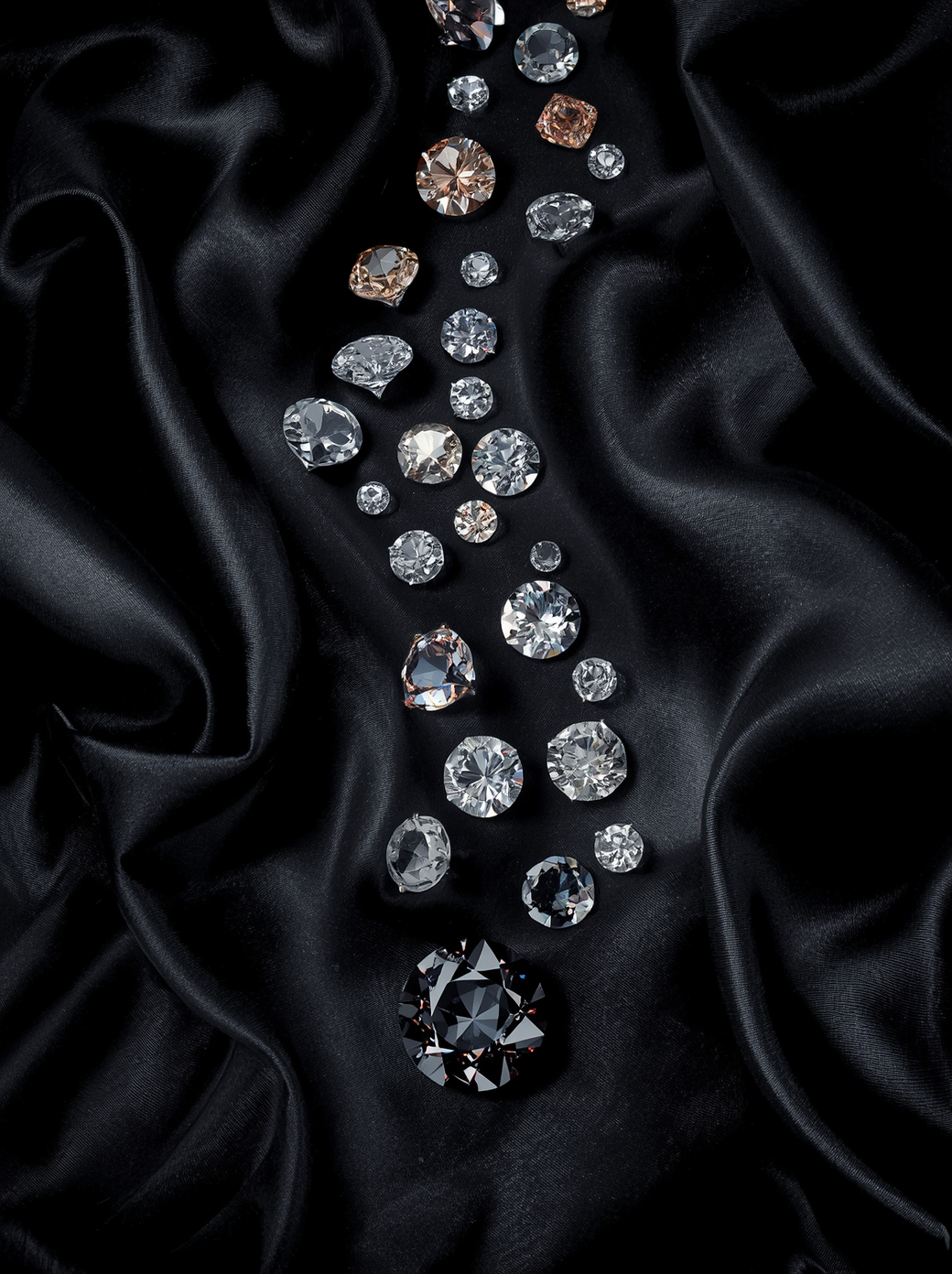
Diamond is the hardest naturally occurring substance on Earth, formed under immense heat and pressure deep in the planet's mantle before being carried to the surface by volcanic activity. The earliest diamonds were mined in India more than two thousand years ago, and for centuries that region was the world's only known source. Diamonds entered the European engagement tradition in 1477, when Archduke Maximilian of Austria gave one to Mary of Burgundy, setting a precedent that slowly spread among nobility before eventually becoming a near-universal custom.
The modern diamond engagement ring as a mass-market expectation owes much to De Beers' 1947 advertising campaign, "A Diamond Is Forever," which reshaped consumer behavior worldwide and cemented the stone's association with eternal love. Diamonds are also graded on the "Four Cs" — cut, color, clarity, and carat weight — a system that became the global standard for valuing the stone. Famous April birthdays include Leonardo da Vinci (April 15) and Queen Elizabeth II herself (April 21).
The modern diamond engagement ring as a mass-market expectation owes much to De Beers' 1947 advertising campaign, "A Diamond Is Forever," which reshaped consumer behavior worldwide and cemented the stone's association with eternal love. Diamonds are also graded on the "Four Cs" — cut, color, clarity, and carat weight — a system that became the global standard for valuing the stone. Famous April birthdays include Leonardo da Vinci (April 15) and Queen Elizabeth II herself (April 21).
May - Emerald
Emerald is the green variety of beryl, prized since antiquity for its rich color, which ranges from yellowish-green to deep bluish-green. Cleopatra was famously obsessed with emeralds, claiming ownership of Egypt's mines and using the stones lavishly in her jewelry and even to impress visiting dignitaries. Long before Egypt's mines were exhausted, the Inca and Aztec civilizations of South America were independently mining and revering emeralds, often dedicating the finest specimens to religious idols and ceremonial objects.
When Spanish conquistadors arrived in the Americas, they seized vast quantities of emeralds from indigenous peoples and shipped them back to Europe, sparking a centuries-long fascination with South American stones. Colombia remains the world's premier source of fine emeralds today, prized for a color so saturated it has its own informal grading vocabulary among gem dealers. Famous May birthdays include Audrey Hepburn (May 4) and Karl Marx (May 5).
When Spanish conquistadors arrived in the Americas, they seized vast quantities of emeralds from indigenous peoples and shipped them back to Europe, sparking a centuries-long fascination with South American stones. Colombia remains the world's premier source of fine emeralds today, prized for a color so saturated it has its own informal grading vocabulary among gem dealers. Famous May birthdays include Audrey Hepburn (May 4) and Karl Marx (May 5).

June - Pearl & Moonstone
Pearl stands apart from every other birthstone because it is organic, formed inside oysters and certain mollusks rather than crystallizing from minerals in the earth. Natural pearls were once so rare that they rivaled diamonds in value, with ancient Chinese, Persian Gulf, and Indian Ocean divers risking their lives to harvest them from the seafloor.
Cleopatra is said to have won a wager with Mark Antony by dissolving a priceless pearl in a goblet of vinegar and drinking it, a story that has endured for two thousand years as a symbol of pearl's legendary worth.
Everything changed at the turn of the twentieth century when Japanese entrepreneur Kokichi Mikimoto perfected a method for culturing pearls, making the gem accessible to a far wider market.
June also offers moonstone and alexandrite as alternates, the latter prized for its rare ability to shift color between green in daylight and red under incandescent light. Famous June birthdays include Marilyn Monroe (June 1) and Paul McCartney (June 18).
Cleopatra is said to have won a wager with Mark Antony by dissolving a priceless pearl in a goblet of vinegar and drinking it, a story that has endured for two thousand years as a symbol of pearl's legendary worth.
Everything changed at the turn of the twentieth century when Japanese entrepreneur Kokichi Mikimoto perfected a method for culturing pearls, making the gem accessible to a far wider market.
June also offers moonstone and alexandrite as alternates, the latter prized for its rare ability to shift color between green in daylight and red under incandescent light. Famous June birthdays include Marilyn Monroe (June 1) and Paul McCartney (June 18).

July - Ruby
Ruby is the red variety of the mineral corundum, and its vivid color comes from traces of chromium; the finest specimens, with a glowing "pigeon's blood" hue, have historically come from the Mogok region of Myanmar.
Ancient Burmese warriors reportedly inserted rubies under their skin before battle, believing the stone made them invincible, while others simply wore the gems set into armor for the same protective purpose. Across medieval Europe, ruby was thought to bring its wearer health, wealth, wisdom, and success in love, making it a favored stone among royalty and the wealthy merchant class.
Hindu tradition refers to ruby as the "king of gemstones," and ancient Sanskrit texts describe it as a stone capable of generating its own inner fire. Today, exceptional rubies routinely command higher per-carat prices than diamonds at auction, a testament to their enduring rarity.
Famous July birthdays include Nelson Mandela (July 18) and Tom Hanks (July 9).
Ancient Burmese warriors reportedly inserted rubies under their skin before battle, believing the stone made them invincible, while others simply wore the gems set into armor for the same protective purpose. Across medieval Europe, ruby was thought to bring its wearer health, wealth, wisdom, and success in love, making it a favored stone among royalty and the wealthy merchant class.
Hindu tradition refers to ruby as the "king of gemstones," and ancient Sanskrit texts describe it as a stone capable of generating its own inner fire. Today, exceptional rubies routinely command higher per-carat prices than diamonds at auction, a testament to their enduring rarity.
Famous July birthdays include Nelson Mandela (July 18) and Tom Hanks (July 9).

August - Peridot
Peridot is one of the few gemstones that forms not in the Earth's crust but deep within its mantle, carried upward by volcanic eruptions; remarkably, tiny peridot crystals have even been discovered inside meteorites that fell from space.
Its signature olive-green color comes from iron, and ancient Egyptians called it the "gem of the sun," mining fine specimens on the remote Red Sea island of Zabargad as early as 1500 BCE. Egyptians often mistook peridot for emerald in dim lighting, and some historians believe several of Cleopatra's famed "emeralds" were actually peridot.
Hawaiian legend associates peridot with Pele, the volcano goddess, claiming the green crystals found on island beaches are her tears, a fitting story given the stone's volcanic origins. Spinel serves as a modern alternate birthstone for August, a gem long confused with ruby and sapphire until mineralogists identified it as a distinct species in the 1700s.
Famous August birthdays include Barack Obama (August 4) and Whitney Houston (August 9).
Its signature olive-green color comes from iron, and ancient Egyptians called it the "gem of the sun," mining fine specimens on the remote Red Sea island of Zabargad as early as 1500 BCE. Egyptians often mistook peridot for emerald in dim lighting, and some historians believe several of Cleopatra's famed "emeralds" were actually peridot.
Hawaiian legend associates peridot with Pele, the volcano goddess, claiming the green crystals found on island beaches are her tears, a fitting story given the stone's volcanic origins. Spinel serves as a modern alternate birthstone for August, a gem long confused with ruby and sapphire until mineralogists identified it as a distinct species in the 1700s.
Famous August birthdays include Barack Obama (August 4) and Whitney Houston (August 9).

September - Sapphire
Sapphire belongs to the same mineral family as ruby — corundum — but is best known for its rich blue color, caused by trace amounts of iron and titanium.
Ancient Persians believed the Earth rested on a giant sapphire, whose reflection colored the sky blue, and the stone became deeply associated with heaven and divine favor throughout the ancient world.
Medieval clergy wore sapphire rings as a symbol of purity and the heavens, and European royalty prized the stone for coronation regalia and crown jewels for centuries.
Sapphire's royal reputation continues today: Princess Diana's engagement ring, a striking blue sapphire surrounded by diamonds, was later given to Kate Middleton by Prince William, keeping the gem firmly in the public eye.
Sapphires also occur in nearly every color except red — a red corundum is simply classified as ruby instead.
Famous September birthdays include Freddie Mercury (September 5) and Beyoncé (September 4).
Ancient Persians believed the Earth rested on a giant sapphire, whose reflection colored the sky blue, and the stone became deeply associated with heaven and divine favor throughout the ancient world.
Medieval clergy wore sapphire rings as a symbol of purity and the heavens, and European royalty prized the stone for coronation regalia and crown jewels for centuries.
Sapphire's royal reputation continues today: Princess Diana's engagement ring, a striking blue sapphire surrounded by diamonds, was later given to Kate Middleton by Prince William, keeping the gem firmly in the public eye.
Sapphires also occur in nearly every color except red — a red corundum is simply classified as ruby instead.
Famous September birthdays include Freddie Mercury (September 5) and Beyoncé (September 4).

October - Opal & Tourmaline
Opal is unlike any other gem in its optical behavior, displaying a flickering "play of color" caused by microscopic silica spheres that diffract light into rainbow flashes.
Australia produces the vast majority of the world's fine opal today, though the ancient Romans also treasured the stone, considering it a symbol of hope, purity, and even believing it combined the virtues of every other gem because of its shifting colors.
For much of history, opal carried an excellent reputation as a lucky and protective stone.
That changed in the nineteenth century, largely because of Sir Walter Scott's 1829 novel Anne of Geierstein, in which a magical opal is linked to a character's death — a piece of fiction that somehow convinced much of Europe opal was unlucky unless worn by someone born in October.
Tourmaline, which occurs in nearly every color of the rainbow, serves as the modern alternate birthstone for the month. Famous October birthdays include Mahatma Gandhi (October 2) and John Lennon (October 9).
Australia produces the vast majority of the world's fine opal today, though the ancient Romans also treasured the stone, considering it a symbol of hope, purity, and even believing it combined the virtues of every other gem because of its shifting colors.
For much of history, opal carried an excellent reputation as a lucky and protective stone.
That changed in the nineteenth century, largely because of Sir Walter Scott's 1829 novel Anne of Geierstein, in which a magical opal is linked to a character's death — a piece of fiction that somehow convinced much of Europe opal was unlucky unless worn by someone born in October.
Tourmaline, which occurs in nearly every color of the rainbow, serves as the modern alternate birthstone for the month. Famous October birthdays include Mahatma Gandhi (October 2) and John Lennon (October 9).

November - Topaz & Citrine
Topaz occurs in a striking range of colors, including pink, blue, and colorless varieties, though it's most traditionally associated with warm golden-yellow tones.
Its name is thought to derive either from the Sanskrit word tapas, meaning "fire," or from Topazios, the ancient Greek name for an island in the Red Sea once mistakenly believed to be its source.
Ancient Egyptians associated yellow topaz with Ra, the sun god, believing the stone carried protective solar energy that warded off harm to its wearer.
Much of the blue topaz seen in jewelry today is naturally colorless or pale topaz that has been treated with heat and irradiation to produce vivid color, a practice that became common in the twentieth century.
Citrine, a yellow-to-orange variety of quartz, serves as November's alternate stone and was historically prized by ancient civilizations who believed it carried the power of the sun. Famous November birthdays include Marie Curie (November 7) and Anne Hathaway (November 12).
Its name is thought to derive either from the Sanskrit word tapas, meaning "fire," or from Topazios, the ancient Greek name for an island in the Red Sea once mistakenly believed to be its source.
Ancient Egyptians associated yellow topaz with Ra, the sun god, believing the stone carried protective solar energy that warded off harm to its wearer.
Much of the blue topaz seen in jewelry today is naturally colorless or pale topaz that has been treated with heat and irradiation to produce vivid color, a practice that became common in the twentieth century.
Citrine, a yellow-to-orange variety of quartz, serves as November's alternate stone and was historically prized by ancient civilizations who believed it carried the power of the sun. Famous November birthdays include Marie Curie (November 7) and Anne Hathaway (November 12).

December - Tanzanite & Turquoise
Turquoise, with its opaque blue-to-green color, has been treasured across more cultures and continents than perhaps any other gemstone, used by the ancient Egyptians, Persians, Chinese, and numerous Native American peoples including the Navajo and Pueblo.
Tutankhamun's iconic burial mask is inlaid with turquoise alongside lapis lazuli and carnelian, and Persian turquoise, mined for thousands of years, has long been considered the finest in the world for its pure sky-blue color.
In the American Southwest, turquoise became deeply woven into Native American art, spirituality, and trade, with Navajo and Zuni silversmiths developing the now-iconic turquoise-and-silver jewelry style in the nineteenth century.
Modern alternates for December include tanzanite, discovered only in 1967 in Tanzania and prized for its blue-violet color, and blue zircon, one of the oldest minerals on Earth.
Famous December birthdays include Walt Disney (December 5) and Jane Austen (December 16).
Tutankhamun's iconic burial mask is inlaid with turquoise alongside lapis lazuli and carnelian, and Persian turquoise, mined for thousands of years, has long been considered the finest in the world for its pure sky-blue color.
In the American Southwest, turquoise became deeply woven into Native American art, spirituality, and trade, with Navajo and Zuni silversmiths developing the now-iconic turquoise-and-silver jewelry style in the nineteenth century.
Modern alternates for December include tanzanite, discovered only in 1967 in Tanzania and prized for its blue-violet color, and blue zircon, one of the oldest minerals on Earth.
Famous December birthdays include Walt Disney (December 5) and Jane Austen (December 16).
